


Inside the World of Perrish 9: An Interview with Vocalist Sarah

Welcome to Hawk-IT Interviews!
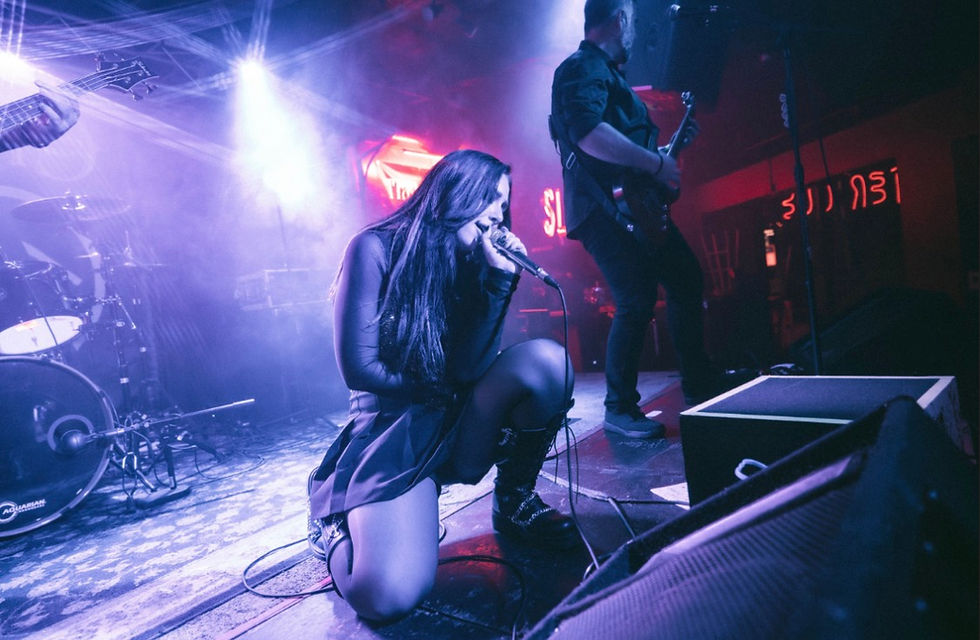
Today, we’re stepping into the world of Perrish 9, a melodic alt-metal/dark pop band that brings together heavy guitars, infectious melodies, emotional songwriting, and a dark, striking visual identity. With influences that stretch across rock, metal, pop, horror, fashion, and visual art, Perrish 9 are creating a sound and aesthetic that reflects their own unique vision.
I recently had the opportunity to sit down for an in-depth Q&A with the band’s lead vocalist, Sarah, to learn more about the person and story behind the music. Throughout our conversation, Sarah opens up about her upbringing, the experiences that shaped her, and the musical journey that ultimately led her to becoming the vocalist she is today.
We also dive deep into the story of Perrish 9, from the band’s early beginnings and the challenges they’ve faced along the way to their songwriting process, creative influences, visual identity, and the personal meanings behind their music. Sarah also shares her thoughts on being a woman in the rock and metal scene, staying authentic as an artist, connecting with listeners, and how Perrish 9 continue to evolve creatively.
We even get into the stories behind several of the band’s songs, including “2 AM,” “Dissect Me,” “The Cycle,” “Dream Within a Dream,” “Seven,” “Seconds to Nowhere,” and “Red Thread,” as well as what Sarah hopes the future holds for Perrish 9.
There’s a lot to unpack in this one, so let’s get into my conversation with Sarah of Perrish 9.
Amit Ahuja: To begin at the very foundation of your story, I’d love to step back into your early years. What was the environment you grew up in like—your hometown, the culture that surrounded you, the people who shaped your life, and the overall atmosphere of your childhood and teenage years? Looking back now, how do you feel those formative experiences, relationships, challenges, and moments of inspiration influenced not only the person you’ve become, but also your emotional depth, artistic perspective, and the way you approach creativity, songwriting, and self-expression today?
Sarah: The environment I grew up in, I tend to categorize into two sections. My early years were the quintessential 90’s and early 2000’s family dynamic. I grew up with two older brothers and a loving mom and dad. Our days were filled with laughter, dreaming, and road trips. My dad was in the coast guard so we moved quite a bit- I saw lots of new places from an early age. I learned to adapt to every new place and the people I met, mastering how to blend in to get by. In my teenage years I faced more changes as most do. At this point in the country, we had been hit by a recession and my family was feeling the after effects of that for years to come. We had settled down in Virginia and I watched my family grow apart. My mother was struggling with alcohol addiction and my brother was diving into the world of drugs. Although things became darker in some ways, we kept our dreaming spirits and laughter.
These experiences shaped me in many ways- something that sticks out to me though is the learned behavior to blend in. With every new state, new school or group of friends, I mastered the skill to be a camelon. Then when there were serious issues within my family, I tried to avoid making waves in an attempt to make life easier for those around me. Like most teenagers, I struggled with my identity, and was not aware of the creative control I could have over myself and my life.
I have spent all of my adult life trying to become the woman 14 year old me would be proud of. Everything I do is for her. I also do it for my dad, who passed away when I was 22. He was the dreamer and was the driving force to fearlessly go after my dreams.
Creatively, these factors have influenced me the most. I dive head first into the things I love and fight for who I am as a person and most importantly who I want to be. You have the power to be a different person than you were the day before.
Amit Ahuja: Walk us through your musical journey. When did music first enter your lives in a meaningful way? Was there a defining moment, memory, or experience that shifted you from simply listening to music into feeling compelled to create it yourselves? For the vocalist specifically, what made you begin singing in the first place, and were there certain artists or influences that inspired you to take it seriously rather than seeing it as just a hobby?
Sarah: Going back to my early years, I grew up in a household of rock, metal, and blues. My parents would regularly go to concerts, some of which were Metalica, Alice in chains, Seether, Breaking Benjamin, Evanescence, Linkin Park, BB King, and many more. When I was 13 or 14, I ventured into learning what music would shape my teenage years. My friends at the time, in rural Virginia, were listening to country and pop music that was on the radio. I started to look on spotify and youtube to find the bands that ultimately lead me to want to be in a band and make music. Through social media I found a band called New Years Day and that changed everything for me. I loved the dark aesthetics with pop hooks and heavy guitars and I was hooked. I went to see them open up for Motionless in White in 2014/15 and it was game over- that’s what I wanted to do.
After that, in my early 20’s, I dove deep into my pop roots with Britney Spears and also discovered Deftones- two of my favorite artists of all time. I studied the performances, the movements, and what made these bands and artists successful.
My parents scraped together some money to get me a few short vocal lessons when I was 15 but beyond that, I hadn't really explored my voice. Regardless, I became obsessed with wanting to front a band when I was 17 and my plan was to move to Atlanta and find a band to join. That’s when I decided it was not going to be a hobby but something that would consume my life. Singing and going after my dream of being successful in my band has been almost like a compulsion ever since. I have to do it, there is no choice.
Amit Ahuja: Every artist eventually finds the genre that feels like home. What initially drew you to rock and metal? Beyond the music itself, what was it about the culture—the emotion, intensity, atmosphere, aesthetics, or sense of belonging—that resonated with you on a deeper level?
Sarah: I have always been drawn to rock and metal and it is partly due to the way I grew up. As a child, I was deeply moved by music and I still am to this day. I would watch these dark music videos that were powerful and moving and not fully understanding what they made me feel- I knew they made me feel something powerful. As I got older I would chase that feeling, getting into heavier and heavier music
To me all music under the rock and metal umbrella feels like an outpour of emotions. It takes everything you have been bottling up and amplifies it to a climax. There is a deep sense of connection between rock and metal bands and their “fans”, that’s unlike other genres. I think at the end of the day, people want to be seen for who they are and accepted anyways- rock and metal culture has always been built on that.
Amit Ahuja: Every musician has artists who leave a lasting impression on them. Looking back on your early years as a musician, were there any female vocalists, bands, albums, or songs that had a particularly profound impact on you? Who are some of your favorites, and what is it about their artistry that has influenced your own approach to singing, songwriting, and performing?
Sarah: I grew up on Evanescence, Flyleaf, Paramore, and many others. Evanescence, in particular, has been a favorite of mine since I was very young. It is undeniable that Amy Lee has influenced me as a vocalist. However, my first ‘favorite’ band- the one I truly fangirled over- was New Year's Day. I loved the blend of heavy guitars and pop vocals. Ash Costello was so visually recognizable; she was like a goth Bratz doll and 14 year old me idolized her.
I got into In This Moment around that time as well and I loved the ultra femininity mixed with heaviness and screaming. I remember seeing Maria Brink share stages with male-led heavy bands, while traipsing around in dresses, delivering shrieking screams. I fell in love with the light and dark duality in these female artists that I discovered early on- the idea that femininity and heaviness did not have to exist separately.
Other notable mentions would be Icon for Hire, Stitched Up Heart, Eths and plenty more. I even explored and studied female rockers from the 80’s and 90’s. I think pieces of all of these artists found a way into me: the heaviness, melodic vocals, the theatricality, and especially the idea that I didn’t have to sacrifice femininity to make aggressive music.
Amit Ahuja: Every band has a moment where everything suddenly clicks. Looking back, when did Perrish 9 evolve from an idea into something you knew had its own identity? Was there a particular song, rehearsal, recording session, or live performance that made you realize this project had become something truly special?
Sarah: As a band, I feel that we did not have that moment where things ‘suddenly clicked’ until about a little over a year ago. We spent many years fighting tooth and nail to make it work, no matter what- even if it did not make sense at times. Once the pieces finally came together, we had a lineup of people who had similar goals and understood and appreciated what Perrish 9 was at that time and what it could be. We started to really discover who we were as a band by writing music and creating music videos for some of the songs we had held onto for so long. We all poured pieces of ourselves into the releases as time went along.
For me, a moment that really stuck out was while we were on set for the Dissect Me music video. This was a big budget production for the band and so much went into it. I was sitting in my big dress in a pile of rose petals and the guys were throwing more into a fan pointed at me. As they cascaded down around me, I became overwhelmed with this sense of knowing that this would be our future (a little bit of manifestation in the moment). I felt so at peace, so in love with what we were creating and I felt so blessed to be in a position where we could do this. Life is about appreciating the journey and I think as a new band, sometimes you forget how special the early on moments are. Every music video, every live performance that passes by, every new song we write, as a band we gain a better perspective as to who we are and where we are headed. We have had many moments where we see how special this project is because it means so much to us- we just want to share that with the world.
Amit Ahuja: The name Perrish 9 immediately captures people’s attention. What’s the story behind the name, what does it represent to you, and has its meaning evolved as the band has grown?
Sarah: This is a great question, we know our name is unique! The name itself did not start out with a deeper meaning to us. It's quite grim but from what I understand, our bassist Bryan was reading an article and it said “nine perish in a fire”- it stuck out to him. The next day he brought it to the band as Perrish 9 and we liked it. Then we added an extra “r” because it looked better to us on paper.
I like anything dark and spooky so I always liked the name. Over the years, we joked that the band has nine lives, like a cat. Every time we die, we come back to life swinging and we probably always will! Although… I can’t say I know what life number we are currently on.. Hah.

Amit Ahuja: Fans often see the finished songs, but they rarely see the obstacles that came before them. Looking back on your journey with Perrish 9, what has been the greatest challenge you’ve faced outside of the songwriting process, and how did overcoming it change you as both an artist and a person?
Sarah: Some people who have been with us since the beginning know this but new people probably don’t. Our biggest obstacle has been simply releasing these songs. We had personal issues happening within our lives, inconsistent members, and a hold on our music for a few years. This taught me that you have to dig in deeper when these obstacles reveal themselves to you. You have to take a self audit and ask yourself, do I really want this? If the answer is yes, you have to ask yourself how far you are willing to go for the things you desire.
We also faced, as many new bands do, people who didn't believe in us or take us seriously. Perrish 9 was joked on little bit in the early days and for someone who was a little shy and insecure when I first started- that can be a hard thing to work through.
This would deeply shape me as an artist and a huge reason why I decide to live authentically these days. I am no longer scared to be perceived. I am no longer scared to be out loud about my band and who I am. Hate gets to everyone sometimes and that's ok. I’m not immune to it even now but as you get older and live more life, it bothers you less.
Amit Ahuja: Every songwriter has a creative rhythm that’s uniquely their own. When inspiration strikes, what does your writing process usually look like? Are you someone who carefully crafts every lyric, or do you prefer following instinct and emotion until the song naturally reveals itself?
Sarah: I do carefully craft every lyric I write but I have to say, I rely on instinct quite a bit. If it is a situation where the instrumentation is created before any of the vocal melodies are thought of, I tend to mumble mouth words and melodies. Oftentimes in that process, certain words will stick out to me. If I am resonating with it, I will use it as a prompt. I’ll try to understand what I am trying to say subconsciously, what is this music making me feel? I usually end up writing something that resonates with me in my current life or a past experience. Other times, I will use a poem I have written and re-work it for the song. It is very interesting when you write music, sometimes you find songs you’ve written in years past will take on a brand new meaning to you as time goes by.
Amit Ahuja: Every song has to begin somewhere. Once an idea starts to take shape, how does it evolve into a Perrish 9 song? What does the creative collaboration with the rest of the band look like, and how does everyone contribute to bringing those ideas to life?
Sarah: The creative process for a Perrish 9 song takes a few different forms. Oftentimes, Bryan, Matt, or Jake will bring a riff or portion of a song to the table. As a band, we will expand upon it together and write parts. James will throw down drum parts, figuring it out in real time, and I will hum melodies. We usually try to record some sort of demo and start solidifying parts after that. Recently, we have been more collaborative with our engineer and exploring what sounds can be created in the studio. I’m lucky to be in a band with great creatives and every single member is capable of writing. I think going forward, people will appreciate the diversity in our sound while remaining very Perrish 9.
Amit Ahuja: Many fans are discovering Perrish 9 today, while others have been with you since the very beginning. Since some of these songs were written nearly a decade ago, it feels like the perfect time to revisit them. Could you take us back to the moments that inspired, 2AM,Dissect Me,The Cycle, Dream Within a Dream,Seven and Seconds to Nowhere? What was happening in your life at the time, what stories or emotions were you exploring through those songs, and when you listen back today, do they still carry the same meaning, or has your perspective changed over the years? As you prepare to release your new single, Red Thread, does it mark the beginning of a new chapter for Perrish 9, or does it feel like a continuation of the story you’ve been telling all along? Finally, what does Red Thread mean to you, and what do you hope listeners take away from it when they hear it for the first time?
Sarah: I’ll start with the newest release of ours, “2 AM”. This song was written when I was in my early 20’s dealing with dating for the first time. I met my first love and unfortunately they were emotionally unavailable. “2AM” has always lived in that really complicated space between loving someone and knowing that the relationship or situation is hurting you. There’s that feeling of, why did you save me just to push me away? It’s about that cycle of being pulled in, pushed out, trying to make someone stay, and realizing how much of yourself you can lose in the process. The song also explores how toxic you can become in that situation as a result. Listening to it now, I understand that emotion differently than I did when I was younger. I don’t think the feeling itself has changed, but I have.
“Dissect Me” is about how self absorbed we can all become when we focus too much on our problems. It’s about getting out of your head and kind of giving yourself a reality check. The song acknowledges that life is really hard and people struggle with serious stuff every day (sometimes it’s inner demons)- but you’re not a lost cause because of it. Like I mentioned before; I live by this motto that, if you really want to, you can be a different person than you were the day before.
“The Cycle” is probably one of the clearest examples of finally reaching that point where you say, “I can’t do this anymore.” The line “Can’t be your martyr anymore” really says it. It’s about recognizing a pattern that you’ve participated in for too long and finally wanting to break it. There’s anger in it, but I think there’s empowerment underneath the anger. I had come out of an abusive relationship at this time and I was searching for my power again. Singing this song made me feel powerful again and that’s just what I needed at the time.
“Dream Within a Dream” is a very emotional song for me. A lot of Perrish 9 songs have this melancholy or dark undertone but with upbeat and heavy instrumentation. This song feels sad to me, start to finish. It is really simple lyrically and that was by design. I was at a point where I felt bad about my life and the decisions I was making and there truly was nothing left to say. I was depressed and I had no more excuses left. I would sit in my two bedroom apartment with my roommate and we would day dream about what the future could look like. I was really obsessed with watching Britney Spears Dream within a Dream tour live DVD and I resonated with those words.
“Seven” was one of the very first songs I wrote lyrically for this project. This song is about trying to search for the part of me that has the power to make my dreams a reality.
“Seconds to Nowhere” was written based off of the audio file that was sent to me by Bryan, our bassist when I first joined the project, (before Perrish 9 became Perrish 9). I loved the name! This is a classic take on the trope of wanting to get out of your home town and the people around you- rising above where you came from and finding your place. For me, nowhere symbolized the possibility of anything, which can be hopeful for someone with less than ideal surroundings who dreams of being anywhere but here.
What’s strange about revisiting older songs is realizing that a song can stay exactly the same while you completely change around it. Some lyrics mean something different to me now simply because I’ve lived more life since writing them. There are things I wrote years ago that I understand better now than I did when I wrote them. Although the lyrics to some of these really old songs are deeply flawed and imperfect.. I feel like sometimes, I write lyrics to my future self. There are messages in those songs that every once in a blue moon when I listen back and I'm like.. Wow, I needed to hear that.
“Red Thread” definitely feels like a new chapter for Perrish 9, but I don’t think it’s disconnected from everything we’ve done before. If anything, it feels like we’re becoming more ourselves. We’re still writing about attachment, pain, love, obsession, loss, fate- all of those very human things but I think we’re getting better at building an entire world around those emotions. However, this marks Perrish 9’s descent into a heavier world, which we have been itching to dive into.
The idea behind “Red Thread” is that invisible connection you can have with another person that seems to exist outside of logic. The idea that maybe there are people we’re tied to somehow, whether it’s across years, distance, different versions of ourselves, or even different lifetimes. That connection can be beautiful, but I didn’t want the song to make it purely romantic. Something can feel destined and still hurt. Something can feel like home and still be dangerous. I set out to write a love song and instead wrote something more real to me. It is a love song but a Perrish 9 love song, hah!
There’s a line, “If the world stopped turning, would our thread lead you here?” that probably sums up the heart of it for me.
I hope when people hear “Red Thread,” they think of their person. And I don’t necessarily mean the person they’re with. Maybe it’s someone they lost, someone they can’t have, someone they haven’t spoken to in years, or somebody they don’t even fully understand their connection to. I want people to be able to put their own story inside of ours.

Amit Ahuja: Growth often comes from taking risks. Were there any songs that pushed you outside your comfort zone, changed dramatically during the writing process, or almost didn’t make the final cut? Looking back, are you glad you trusted those creative instincts?
Sarah: Absolutely. I actually think some of our best moments happen when something initially feels a little uncomfortable.
I don’t want Perrish 9 to get to a point where we know exactly what a “Perrish 9 song” is supposed to sound like and then just keep rewriting it. I love heavy music, but I also love pop music- that goes for the guys as well, they are influenced by a vast majority of different genres. I love beautiful melodies just as much as I love screaming. Sometimes those instincts fight each other during the writing process, but I think that tension is part of what makes us sound like us.
I’m glad we stuck to our guns about releasing old material, it's a healing thing to give your past self the chance that it deserved at the time. I’ve learned that if something makes me slightly nervous creatively, that’s usually worth paying attention to. The safest decision isn’t always the most interesting one.
Amit Ahuja: One of the things that resonates most with listeners is how personal your lyrics feel. When you’re writing, how do you decide which emotions or experiences are worth turning into songs? Do you usually write from personal experience, or do you also draw inspiration from stories, observations, or imagination?
Sarah: Almost everything I write starts with a real emotion. It doesn’t necessarily mean every lyric is a literal retelling of something that happened to me, but I need to understand the feeling underneath it.
Sometimes I’ll take something very small that happened to me and exaggerate it into this huge world. Sometimes I’ll combine different experiences. Sometimes one line comes from something completely real and everything surrounding it becomes a metaphor. That’s probably why there is so much imagery in our lyrics. Saying exactly what happened isn’t always interesting to me. I’d rather tell you what it felt like. And once the song starts becoming its own thing, I don’t feel like it belongs exclusively to whatever originally inspired it anymore. That’s when imagination starts taking over.
I do write a lot of poems inspired by dark movies, shows, and stories I like a lot. So I think when the occasion calls for it and I'm done purging for a bit, I’ll write some lyrics surrounding the art that inspires me.
Amit Ahuja: Part of what makes Perrish 9’ s music so engaging is that listeners often walk away with their own interpretations. Do you intentionally leave parts of your songs open-ended, or do you usually have a very specific meaning in mind and enjoy seeing how people connect with them Differently?
Sarah: Usually I know exactly what I’m writing about.But I don’t necessarily want you to know exactly what I’m writing about. I love that distinction. There are details I’ll intentionally leave vague because I think the listener deserves to have their own relationship with a song. If I explain every person, every situation and every metaphor, I’ve almost taken something away from them. Sometimes even, there is no metaphorical veil and that's ok. Simple lyrics can be powerful too.
Once we release a song though, it isn’t completely mine anymore. Everybody gets to bring their own life into it.
Amit Ahuja: The visual identity of Perrish 9 is just as recognizable as the music itself. How important are photography, artwork, fashion, lighting, and the overall aesthetic in creating the band’s world? Do those visuals develop alongside the music, or do they naturally come together afterward?
Sarah: It’s so incredibly important to me, I lie awake at night thinking about how I can be more creative visually. The visuals aren’t decoration around the music, they’re part of Perrish 9’s world we are building. I’ve always been obsessed with artists where you could almost understand the world they lived in before hearing a note. Photography, clothes, makeup, lighting, artwork, videos… all of it can tell the same story as a song.
My personal taste has always lived in contrasts. I love something very feminine next to something ugly or unsettling. Glamour next to horror. Pop next to metal. Something beautiful that feels slightly wrong. Visually, I’m also very drawn to things like Tim Burton, Guillermo del Toro, old horror, German expressionism, vintage imagery, Y2k Playboy- anything that feels like you’re entering another little universe.
Sometimes the visual comes after the song, but lately they’re developing much more simultaneously. I’ll be writing and already seeing clothing, lighting or scenes in my head. I want each Perrish 9 era to feel like somewhere you can actually step into, we are working on that and trying to get better with each release but it can be hard as an indie band on a budget.
Amit Ahuja: The world of rock and metal has evolved tremendously over the years, with more women stepping into the spotlight and redefining what it means to front a heavy band. Looking back on your own journey, what has it meant to you to be a female metal vocalist? How has that experience shaped your confidence, your artistry, and the way you see your place within the genre today?
Sarah: Being a woman in rock and metal has been a really interesting evolution for me because I think when you’re younger, you can feel this pressure to prove that you’re “cool enough.” I’ve gotten much less interested in proving that. I love being feminine. I love pop vocals. I love makeup, fashion and beautiful things. And I also love screams off over a disgusting guitar riff, all metal subgenres including hardcore and deathcore.
If anything, being a female vocalist in this genre has made me more confident about leaning into the things that make me different instead of trying to neutralize them. I don’t want to be “one of the guys.” I think there are more women doing that now than ever, and it’s really exciting to watch. Just as I support and uplift women in the genre, I do with men as well. There are so many male led bands that I listen to daily and admire. There’s really room for everyone and I love that.
Amit Ahuja: Artists often don’t fully realize the impact their music has until they hear directly from the people it has reached. Has a fan ever shared a story about one of your songs that completely changed the way you viewed your own work?
Sarah: Absolutely, we’ve just started this journey and I am taken back when we have one of those moments. Specifically, I get surprised at which songs people pick to resonate with. I’ve been seeing more people who discover us bumping the really old songs that I tend to downplay sometimes because I feel my writing wasn’t up to par.
I’ve had a really special full circle moment with a friend who’s been a major fan of the band for a long time, she was married to an ex member of the band and our songs took on a whole new meaning for her. She is a ride or die and comes to every show no matter what till this day. While I won't share the details of her story, I will keep her story close to my heart.
Amit Ahuja: Writing honestly requires vulnerability, but Everyone also needs boundaries. Once those songs are out in the world, how do you separate Sarah the artist from Sarah the person? Has sharing such personal music ever made you rethink where you draw the line between honesty and privacy?
Sarah: I think I’m still figuring that out. Writing is probably the place where I’m least guarded. There are things I can put into a lyric that I would have a very difficult time just sitting across from someone and saying out loud. But there’s also a difference between being honest and giving everyone unlimited access to you.
When I was younger, I think I felt like vulnerability meant telling the entire story. Now I understand that I can tell the emotional truth without explaining every detail of my personal life or identifying who or what something was written about. Sarah the person gets to keep things. Sarah the artist can take the feeling from those things and turn it into something else.
Amit Ahuja: Creating emotionally intense music takes a A lot of energy. When you’re not making music, What helps you disconnect and recharge? Are there hobbies, books, films, art, or experiences that quietly find their way back into your Songwriting?
Sarah: I need things that have absolutely nothing to do with music. I love creative things in general, so even when I think I’m “disconnecting,” I’m probably still collecting inspiration without realizing it. Movies, fashion, photography, decorating spaces, weird old imagery, those things inevitably sneak back into what I create. I’m a huge visual person. I can watch a movie and become obsessed with one room, one costume, one lighting choice or one tiny shot and somehow that ends up influencing an idea months later.
I also just really value normal life. I love to throw themed get-togethers, travel with the people I love, play with my dogs, and enjoy a good dinner out. I can’t say I love to cook, that would be a lie! I love learning and history, you can catch me at a museum or watching endless hours of youtube on a specific topic.
Amit Ahuja: Fans often feel like they know an artist through their music and social media, but there’s always another side people rarely get to see. What’s something about Sarah that would genuinely surprise people?
Sarah: I think people who only know me through Perrish 9 probably expect me to be more serious than I actually am. I’m obviously drawn to dark music and dark imagery, but I’m also kind of wide-eyed and whimsical. I love making costumes, decorating, throwing themed parties, and I can get way too excited about completely mundane things. But honestly, I wear my heart on my sleeve- what you see is what you get.
Amit Ahuja: A Perrish 9 performance is about much more than simply playing songs. When someone experiences the band live for the very first time, what do you hope they feel, and what do you hope they’re still thinking about long after they’ve left the venue?
Sarah: I want somebody who has never heard us before to look up when we start playing. That’s the first goal. I want people to walk away having felt seen, I want this symbiotic relationship between the audience and our band performing.
There’s obviously the heaviness and energy of the music, but I want there to be atmosphere too. I want people to remember what they saw, what it felt like, what I was wearing, what the room looked like, the moments where everything got quiet and the moments where the energy was palpable.
Amit Ahuja: No artist creates in a vacuum. Looking back, who or what has had the greatest influence on your artistic philosophy and the way you create music today—whether musicians, writers, filmmakers, visual artists, family members, mentors, or even fictional characters? What lasting lessons have they left with you?
Sarah: There isn’t one person. I’ve spoken about the bands that influenced me and who I grew up with. But film and visual art influence me almost as much as musicians do. Tim Burton, Guillermo del Toro, German expressionism, old horror films, stop motion.. I’m drawn to artists who don’t just create a piece of work; they create a recognizable world with mediums that make you feel something. Some of my favorite movies like Coraline and Alice in Wonderland explore this need to go beyond the world they know and deal with the challenges they face beyond that little door- in the name of finding a world beyond their own.
That’s probably the biggest lesson I’ve carried into Perrish 9. I don’t just want to write songs. I want us to build a world that could only belong to us that I can share with people who want to exist in it.
Amit Ahuja: Your music paints incredibly vivid imagery. If one Perrish 9 song became the soundtrack to a horror film—or inspired an entire movie or video game—which song, would you choose? What story would it tell, and what kind of world would audiences' step into?
Sarah: This is a fun time to plug that “The Cycle” is actually in a horror movie soundtrack! It’s called Devour and I think it’s making its rounds on the indie horror festival circuit right now. It features Hedi Sheppard as the lead from the band Butcher Babies and it was such a cool moment to see our name on the soundtrack.
“Red Thread” is my answer though for the song that a movie could be created around. Visually I’d want it to feel beautiful and romantic at first and slowly become claustrophobic and surreal, a psychological thriller. By the end, you’re not sure whether you want them to cut the thread or follow it.
Amit Ahuja: There’s often a very real connection between creativity and mental health, especially within emotionally intense genres like rock and metal. Throughout your journey with Perrish 9, how have you learned to navigate that balance? What habits, practices, or support systems have helped you maintain your well-being while pursuing something that can be so emotionally demanding and deeply personal? Has your relationship with creativity and mental health changed over the years, and if so, in what ways?
Sarah: I think for me, so far this project has just been therapeutic- when we talk about creativity. Now, I know a lot of bands and artists can understand this, but it feels like the goal post is always moving for new artists, you have to be a team of 20 with only 4-6 members. It seems like there are so many obstacles to get where you need to go.
I also have a hard time not comparing myself to others on social media, but I think that’s a universal problem for a lot of people right now. I think it’s helpful to ground yourself and try to do things that take you out of yourself. I’m talking about simplicity, meaningless games and adventures that are only there to get you out of your head. I remind myself often not to take myself too seriously.
Amit Ahuja: Looking across Perrish 9’s catalog today, is there one song that you feel captures the band’s identity better than any other? What makes that track the one that best represents who Perrish 9 is today? As you look toward the future, where do you see Perrish 9 going creatively over the next few years? Are there new sounds, collaborations, visual ideas, or artistic challenges you’re excited to explore? Ultimately, what kind of legacy do you hope the band’s music leaves behind?
Sarah: Right now, I honestly think “Red Thread” is the closest we’ve gotten to capturing where Perrish 9 is going. It has heaviness, melody, atmosphere and that slightly cinematic darkness I want more of. It doesn’t feel like we’re abandoning the older version of the band. It feels like we’re taking everything we’ve learned from it and becoming more intentional. Going forward, I want fewer rules.
I want heavier moments to get heavier and pop moments to be allowed to be unapologetically catchy. I want to experiment more with sound and production. I want visuals to become bigger, stranger and edgier. I want collaborations that people wouldn’t necessarily expect from a metal band.
As far as legacy goes, obviously we have big dreams. But underneath all of that, I want somebody years from now to find one of these songs during exactly the period of their life when they need it. The music that shaped me did that. If we can leave something behind that does that for somebody else, that’s a pretty incredible legacy.
Also.. I want my future kid to think I was cool.
Amit Ahuja: Finally, every artist’s journey is filled with lessons learned along the way. If you could sit down with the younger version of yourself who was just beginning to dream about becoming the artist you are today, what advice would you tell her about creativity, success, perseverance, and staying true to yourself? And for anyone reading this who’s chasing their own creative dreams, struggling to find their voice, or feeling misunderstood, what message would you like to leave them with?
Sarah: I’d probably tell the younger me to stop trying so hard to figure out what everyone else wants from her and stop taking everything so seriously. The things you’re tempted to edit out of yourself because they don’t fit neatly together are eventually going to become the most interesting parts.
I’d also tell her that success takes so much longer than you think it will and to start putting out art NOW. Even if it’s not perfect, create and learn.
And to anybody who feels misunderstood: being understood immediately isn’t necessarily the goal. Find the thing that feels unmistakably like you, then protect it long enough for everyone else to catch up.
Amit Ahuja: And that brings us to the end of our Hawk-IT interview with Sarah of Perrish 9.
A huge thank you to Sarah for taking the time to share her story, the journey behind Perrish 9, and the inspiration and meaning behind their music. With “Red Thread” opening an exciting new chapter for the band, we’re looking forward to seeing what Perrish 9 have planned next.
Be sure to check out Perrish 9’s Linktree below to follow the band, listen to their music, and stay up to date with their latest releases.
Thanks for reading and stay tuned to Hawk-IT for more artist interviews and music features!

Please check out Perrish 9’s Linktree below, where you can follow the band, stay up to date with their latest releases, and listen to their music.
Sarah's IG Page:
***Photography featured in this Hawk-IT Media interview is courtesy of Andrew Burn, Lauran Jones, and Linus Ingram. Video footage is provided courtesy of Perrish 9.***


Comments