
Meet Giovanti Alves: The Visionary Behind Lust 4 Blood


Welcome to Hawk-IT Interviews. Today, we’re sitting down with Giovanti Alves—the creative force behind Lust 4 Blood. Emerging from California’s Bay Area, Alves launched the project in 2016, shaping it into a distinctive voice in alternative music.
Blending pop sensibility with a meticulous eye for detail, Lust 4 Blood moves fluidly across styles while staying rooted in raw expression. Giovanti’s work stands out for its infectious melodies, unfiltered honesty, and electrifying live energy—paired with a songwriting approach that refuses to play it safe.
With ambitions that stretch far beyond the ordinary, Giovanti is on a mission to take Lust 4 Blood across the globe—and maybe even beyond—connecting with listeners in a way that feels personal, immediate, and unforgettable.
Let's begin!!
Amit Ahuja: To start at the very foundation of your story, take us back to your earliest memories. What were the environments you grew up in like—your hometowns, the culture, the energy, the sense of community? How did those surroundings—the people, the atmosphere, the challenges, and the opportunities—shape your emotional and creative development during your childhood and teenage years?
Giovanti Alves: When I was a kid growing up I had a lot of support from both of my parents. My mom introduced me to a lot of important music growing up. She sadly passed away in December of 2024, but she was incredibly supportive of me and the music. I grew up in a small suburban town almost no one has heard of called Cotati. Cotati is located in the Northern Bay Area in California. I have lived here in the Bay Area my whole life. I went to a lot of metal, hardcore and punk shows in middle school and high school and was shaped by alternative culture from an early age.
Amit Ahuja: Looking back now with a bit more perspective, how do you feel those formative years influenced the person and artist you’ve become? In what ways did your upbringing shape your worldview, your emotional depth, your resilience, and ultimately the way you approach creativity and self-expression today?
Giovanti Alves: My formative years influenced the person and artist I became in so many ways. As I said my parents were both very supportive and I've always had a very sensitive and empathetic disposition. My worldview in my youth was definitely one of pessimism. But looking back now with more perspective I can say that being a disaffected alternative person made me proud of who I am. Now I'm incredibly optimistic. Happy actually. I'm far more extroverted and social then I was when I was a kid. Many things in regard to creativity are the same, I like to experiment and try new things.
Amit Ahuja: Walk us through your musical journey. When did music first enter your life in a meaningful way? Was there a defining moment, memory, or experience that shifted you from being a listener to feeling compelled to create?
Giovanti Alves: I've always been obsessed with music. It's always had meaning for me. I don't know that there was a single defining moment so much as defining experiences. The first show I went to was with my mom. It was a free show at San Francisco City Hall to advocate for studio space for artists and musicians. Green Day headlined the show and I remember how powerful it was. How powerful punk rock and music could be. I've always wanted to create music; I got my first instruments when I was incredibly young. I've been playing music in some form or another my whole life, I've never stopped and never will.
Amit Ahuja: What initially drew you into the genre you focus on today? Beyond the musical intensity or structure, what was it about the culture, aesthetic, emotional depth, or sense of belonging within that scene that resonated with you on a personal level?
Giovanti Alves: This is a particularly interesting question because my music doesn't exactly fall into a certain genre or subgenre. But I was drawn to electronic music because I could do things with it that I wasn't able to with physical instruments. I've been a producer since high school. What I love about electronic music is that I can create all these different sounds using a sonic pallete and really express my emotions in a different way then just for example, writing a song on guitar. There's actually plans for an acoustic Lust 4 Blood album that will be out in September 2026, but what drew me to electronic music was definitely the intensity of it. The Prodigy is a major influence on me. When they dropped "The Fat of The Land" in 1997 it absolutely changed my life. Also obviously Marilyn Manson has been a major influence on me as an artist and person. I've always liked the goth aesthetic and the emo aesthetic and culture equally. I was a scene kid growing up, not much has really changed there. It's not a phase.
Amit Ahuja: Looking back on your early influences within the genre you focus on, were there specific artists, albums, or moments that helped shape your approach to both sound design and performance? How do those influences still surface in your work today?
Giovanti Alves: When I started making as Lust 4 Blood the primary influences were Synthpop and Goth artists. I was listening to a lot of IAMX, Apoptygma Berzerk, Solar Fake, Nine Inch Nails. I wanted to create something dark and complex like those artists. Something I could really put my emotions into. IAMX is a great example of an artist who really pushed me to create complex works of music production wise. Also the vocals have always been important. Some albums that really influenced the project heavily early on are:
Solar Fake - Reasons To Kill
IAMX - Volatile Times
Marilyn Manson - The Golden Age Of Grotesque
Razed In Black - Damaged
Nine Inch Nails - The Fragile
These influences are still very strong in my work, even though Lust 4 Blood has branched out beyond Synthpop. Now the project is kind of an amalgam of Hyperpop, Emo, Goth, Industrial, Scenecore, Synthpop, and EDM. Whenever people ask me what genre of music I make I always tell them Alternative Pop music. It saves a lot of explanation and dissecting for people who aren't familiar with these subgenres.
Amit Ahuja: Looking back to when you first started, how does the scene feel different now—not just in terms of sound, but in the way people engage with music, build audiences, and define what it means to “belong” to a movement?
Giovanti Alves: I mean, not just the scene and the industry are completely different than they were when I started this project 10 years ago. In many ways things are the same but I feel there is maybe less people going out to events, or if they do go out it's to the bigger ones. I remember when small club nights and independent shows were still a big deal. The one thing I will say though is that alternative culture in general has had a major resurgence within the past few years. The industry is different because pretty much everyone streams things and not a whole lot of people listen to just physical copies of music anymore. Although vinyl has definitely had a comeback. As far as belonging to a movement, I have always wanted to be able to do what I'm doing now. Playing with all different types of bands and artists, going on tour, producing and doing whatever I want with my music. The response to what I've been doing these past few years has been fabulous. People really like the songs and what I'm doing.
Amit Ahuja: Do you feel rooted in a community within this world, or has your path leaned more toward independence—and how has that relationship (or distance) shaped both your sound and your sense of identity as an artist?
Giovanti Alves: Both. As an artist I would say I'm definitely leaning more towards independence, but as a person and performer I love the community surrounding me. I have an incredible network of people in my l because of the music.
Amit Ahuja: When you take a step back and look at your journey from when you first started out to where you are now in 2026, how do you reflect on your growth as an artist? There’s often a huge difference between those early days—when everything is raw, experimental, and still taking shape—and the more refined, intentional work that comes later. What stands out to you the most when you compare those two versions of yourself?
Giovanti Alves: I have changed in so many ways in the last 10 years of making music as Lust 4 Blood. When I started I was introverted, unsure if I was going to ever be successful with this, and I had a lot of issues that have either been resolved completely or gotten better. I'm really proud of the person I've become. There's also some history with addiction and self-destructive tendencies but I'm going to leave those details for the documentary that I'm working on, look for that in 2027. It's going to be a really cool film. More on all that later.
Amit Ahuja: Beyond the initial shock value, there’s a sense that the name carries a deeper conceptual or symbolic weight. Does it tap into specific themes you explore in your music—whether that’s desire, pain, transformation, or something more abstract? And how does Lust 4 Blood fit into the larger world you’re building as an artist? In what ways does it reflect your identity, your creative philosophy, and the emotional landscape you want listeners to step into when they engage with your work?
Giovanti Alves: Thank you for the compliments on the name! So when I started taking music seriously and producing as a solo artist with this type of music I was under a different name: Dream Heavy (2010-2015). At the time I was only releasing my music on SoundCloud and someone else on the platform took my name! So it was time for me to pick a different one. A better one. I had a few different ideas. This project was almost called CHROMESKVLL. I was really into the Laid To Rest movies at the time and it seemed like a cool name but I decided against it. It just didn't work. I can't really say how I got the name Lust 4 Blood, it just kind of came to me. I loved the sound of it and I was always told if you can see the name in block letters on a marquee that it's probably the name you should use, and I saw that in my mind with Lust 4 Blood. It was admittedly spelled Lust For Blood in the beginning, but I changed it to Lust 4 Blood for aesthetics and other reasons. I was born on May 4th so there's some definite symmetry there. This project has a lot of synchronicity going on. A lot of synergy. I guess what the name represents to me on a personal level is the idea of Lust being a driving force of sex and desire, and Blood being symbolic of emotions and empathy, of the life force. People have asked me if I'm a vampire and I'm not going to comment one way or another. Take me to your bedroom and find out!
Amit Ahuja: Your new album, A Dream Within a Dream, feels expansive, almost like a world of its own—layered, introspective, and conceptually rich. Take us inside the making of the record. What was happening behind the scenes as it came together, and what kind of creative or emotional space were you in during its creation? I’m especially curious about the journey from idea to execution—how did this project evolve from its earliest vision into the final body of work we’re hearing now?
Giovanti Alves: This project has always revolved around empathy and a strong visual sense. Desire is definitely a theme. All of my lyrics draw on personal experience. When I started out I was incredibly picky about the words that I use in the songs. Now I often don't even write the lyrics down. I'll just do my vocal takes freestyle. Stream of consciousness lyrics. The themes I tend to explore the most are romance, addiction, sex, transformation, empathy, and questioning reality. As far as the larger world I'm building, I feel there's no limit to what I can do with Lust 4 Blood. I can make any type of music and have it fit into my catalog in a sensible way. I can take on any type of projects. I've had ideas for a video game in the future, there's already a concept for it. The possibilities with what I do are endless. I've been told that my music is confrontational and unapologetic and I feel that that's true. As far as how the concept and name fit my identity, they are my identity. This is all encompassing and I stand behind and in front of everything I do 100%. I don't do filler and I don't do fake. But like I said about transformation, this has been a transformative process and I would like it to be for other people. I feel that the visuals in terms of the cover art, live performances, theatrics, and music videos have to be on a certain level as well. I hold myself to a certain standard. I definitely want people to connect to the songs on the level that I do, especially the ones that made me cry when I was writing them.
Amit Ahuja: The decision to include 24 tracks is striking in itself—it’s ambitious and suggests there’s a lot you wanted to explore. What drove you to build something on that scale? Was it about storytelling, capturing a specific state of mind, or giving each idea the room it deserved rather than cutting things down?
Giovanti Alves: This isn't the first record I've done with a long track listing. "GO SHARP LEFT" has 27 tracks on it. "I Did It All 4 Love" has 23. Thank you for mentioning the word ambitious, I've always thought of myself as being so. The reason I decided to make this another long record was mainly because I wanted to do a lot of different sounds on it, as well as there being a concept that I wanted to explore as much as I could. For me it's always about storytelling. Every record I do tells a story. You mentioned also giving each idea the room it deserved and I feel that that was important for this album. Every song has its own concept and part of the story. I don't really mean a story in a linear sense, because we're dealing with dreams and unreality here. But it's a story in the sense that it's broken into three parts, there's the intro "In Death Dreams Doth Dwell..." leading into the first third of the album, and two interludes to break up the other two-thirds of it. The last two songs really give it a strong finish I think. "The Shadow Archetype" hits really hard and is one of my heaviest songs, and the song that follows "Shadow" and closes the record is "Eternal Peace." It's a really great song to end on I feel it's emotionally powerful in all the right ways.
Amit Ahuja: When it comes to songwriting, can you walk us through your lyrical inspiration? Whether it stems from personal experiences, relationships, internal struggles, stories you’ve encountered, or more abstract ideas—how do those influences shape your writing and creative process?
Giovanti Alves: I always write from a place of authenticity. As I mentioned previously I used to write the lyrics down, but now I just write while doing my vocal takes. Sometimes I still write the words down, especially when it comes to the hooks of the songs but for these past few albums I basically just get ideas from the instrumentals and the feeling of the song itself. I definitely draw on personal experience more than anything else but I feel that a lot of the ideas could be viewed as abstract in some ways being that I put a lot of visual and colorful language into the lyrics. Also I've noticed that there's less songs with explicit lyrics on "A Dream Within A Dream". I always want to write emotional, intelligent, and honest lyrics. The words are definitely important because I'm painting a picture with them.
Amit Ahuja: And when listeners dive into the album, certain tracks stand out as emotional or conceptual anchors—songs like “Lucidity,” “Discordia,” “Glow (In the Dark),” and “Daydream Delusions.” Can you unpack some of the meaning behind these titles and what they represent within the larger narrative of the album? How do they connect to the themes you’re exploring, and what do you hope listeners take away from those moments specifically?
Giovanti Alves: "Lucidity" was one of the first songs to be finished on the production side of things, and one of the last I tracked vocals for. I knew I had to set a strong tone with that song because I knew it was going to open the record. I've also been opening my shows on this tour with it. "Discordia" has some of the most metaphorical lyrics on the record, and is one of the most melodic. One thing I really like about this record is the vocal work that I did on it. "Discordia" is a great example of me hitting high notes, especially at the end. "GLOW (IN THE DARK)" is definitely one of my favorites on the record, but I love every song! What I really like about that one is that it's catchy, I'm doing some lower range vocals on the hook and it's just a fun song. There will definitely be a music video for that one. "Daydream Delusions" I think really hits the mark on the idea of questioning reality. It's a really cool song and I love the heavy chorus in it. I've also been playing that one live and it has a certain atmosphere when I perform it. What these songs represent in the larger theme of the record are like you said, focal points for the record. Some other examples would be "Subliminate", "On The Other Side", and "The Shadow Archetype". My hope is that listeners will get a sense of unreality from listening to this record. The idea was to be incredibly visual with it and I hope that people get that. The response to this record has been incredibly positive, I've heard nothing but good things from people so they're definitely relating on the level that I intended.
Amit Ahuja: Looking ahead to your upcoming project, can you share more about its direction and what sets it apart from your previous work? When starting a new track, what usually ignites the creative process for you—whether it’s a sound, a rhythm, or a concept—and how does that original idea transform as the piece develops?
Giovanti Alves: My process is very spontaneous. The ideas just pop into my head. Sometimes it definitely feels like I'm possessed, not like in the sense of being possessed by a demon or anything. I guess what I mean is that I feel like I'm just getting started, even though I've been making music as Lust 4 Blood for 10 years. I get inspired by just about everything and that compels me to write music. I've also done versions of a lot of my songs on acoustic guitar, piano, and other instruments. I'm working on music every day and have been for the past 3 years. There was a period between 2019 to 2024 when things were moving a lot slower with this project, but now it's all encompassing and I am 100% Non-Stop. Looking ahead to the next project I get really excited because it's going to be a record based around songs that I'm writing on acoustic guitar. There's three songs written for it so far. It's going to be a shorter record this time. 9 or 10 songs total. There is a title for it as well as a concept for the cover art. I'm going to be capturing the making of this album in the documentary that I'm working on right now as well. All I can really say about it without spoiling it completely is that it will be out in September and these will be all new songs using acoustic guitar and other live instruments, like harmonica, xylophone, etc. No digital production. No drums. All new songs not acoustic versions of the ones I've done already. I'm pretty excited for it. It's going to be very organic.
Amit Ahuja: On a more personal note, who are three individuals who have had a profound impact on your life—artistically or personally? What lessons did they teach you, and how do those lessons continue to influence you today?
Giovanti Alves" My Mom. She always taught me to look on the bright side of life and to embrace my creativity. I miss her a lot, I know she would be proud. A lot of what I do know is for her. We had a lot of good times together. She took me to a lot of shows and was a very cool lady.
Marilyn Manson. Who I also mentioned previously had a major impact on me. "Golden Age Of Grotesque" is still my favorite album of all time. Nothing else sounds like that record. His music and art really inspired me to do what I do now. I've had the pleasure of meeting him twice. He's a total sweetheart, despite the rumors and controversy that have surrounded him over the years. He taught me to always believe in myself and to push the boundaries of what is possible.
Amit Ahuja: Outside of music, what are some of the hobbies or interests that really inspire you? Whether it’s films you love, books you get lost in, or any kind of art you connect with, what naturally draws your attention—and how do those interests influence you creatively, if at all?
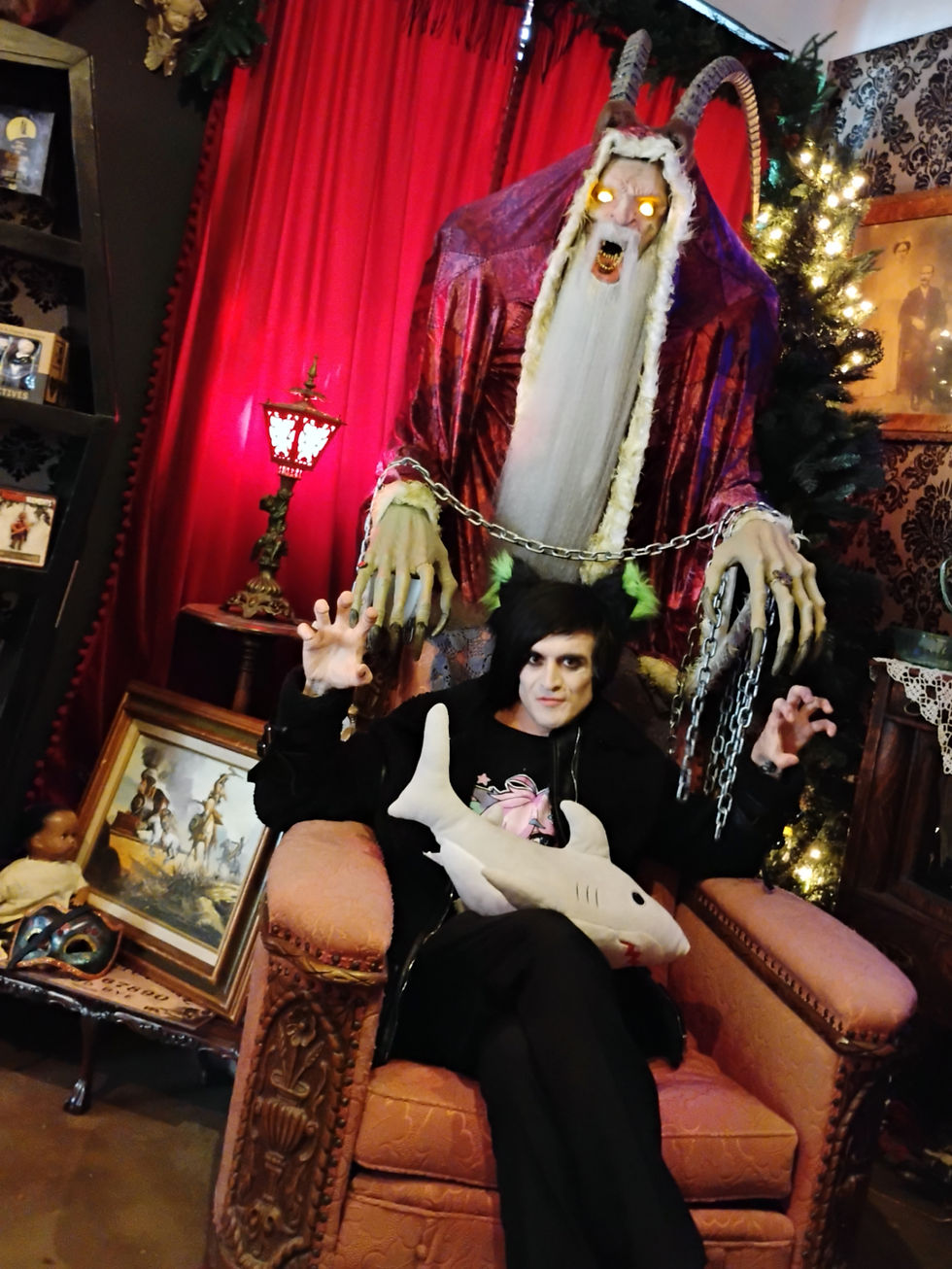
Giovanti Alves: Not that you're calling the music a hobby!!! To be honest I don't have any of those. It kind of irks me when people refer to the music as a hobby but once again I'm not saying that you are, and frankly anyone who's calling it that is entitled to their opinion. This is my passion and I put 100% into it. I give it everything I have. As far as other interests, I really like movies and reading although I probably don't do enough of either being that I'm swamped with music these days. But I also really enjoy nature and animals. I have a plushie shark that I bring everywhere with me on tour and when I leave the house. His name is Sharky and he's basically the other member of Lust 4 Blood. He's been coming out on stage with me when I perform "THE BEST OF ME". Sharky loves that song. It is a ritual for us to perform it together now. I like to paint as well as draw, art is my other creative endeavor. A lot of people don't know that I make art. I also really like photography, and making content for Instagram. People don't realize the amount of promotion and networking that I do to make the shows possible. I book nearly all the shows myself. What naturally draws my attention is things that are cute. I have a thing for cats obviously. I also have a thing for femboys, I'm gay. Pansexual but mostly gay. Books, films, and art that draws my attention is the stuff that really makes you think. Some film directors I like are Stanley Kubrick, David Lynch, and Wes Anderson. I like all kinds of art including digital art. I've had the privilege of working with some fabulous digital artists and it's absolutely amazing what they do. I also have a thing for cemeteries, oddity shops, and museums.
Amit Ahuja: On a deeper level, what does creating music represent for you personally? Does it feel like catharsis, self-discovery, confrontation, healing—or some combination of all of those? How do those emotional states influence what ultimately makes it into your songs?
Giovanti Alves: All of the above definitely. I've always loved that word catharsis. I've definitely been told that my stuff is cathartic and frenetic. Really high energy. As far as the emotions, I like to play on optimism more than anything else. Even if what I'm writing about is really dark I always find a way to put a positive spin on it. I want the music to make people feel good regardless of how I feel. The emotional authenticity of what I do is literally the most important aspect of this project.
Amit Ahuja: The creative journey is often filled with rejection, setbacks, and moments of self-doubt. What advice would you give to emerging artists navigating those challenges? How can they turn those experiences into motivation and long-term growth?
Giovanti Alves: Find what you like to do and keep doing it. If people question what you're doing, or it makes people question things then you're doing it for the right reasons. Even if it's entertaining people and making you happy you're doing it for the right reasons. If you have doubts, know this: 3 years ago I wasn't getting shows booked. I wasn't sure if I was ever going to be on the level that I am now, and I am. Be persistent and never give up. If you have setbacks, as we sometimes do in life find strength in adversity and put that into your art or whatever you're doing. We live in an amazing time. I'm fascinated by all the things that people can do and achieve if they believe it is possible. On that note I don't believe that anything is impossible. To quote Rocky Horror: "Don't dream it, be it!"
Amit Ahuja: If you could place your music in any film—classic or modern—which would you choose, and what kind of moment or scene do you imagine your songs soundtracking?
Giovanti Alves: Whoa!!! What a trippy question! Hard to decide as well. So many of the movies that I like that make me cry or that had an emotional impact on me have great scores, like The Life Aquatic. That scene with Bill Murray and the shark always gets me. Sigur Ros are actually one of my favorite bands. Radiohead too. I love atmospheric music like that. But if I had to decide, I would say Night of the Demons. The original! Not that god-awful remake that they did. Night of the Demons is a 1980s cult classic horror movie and is one of my favorites.
Amit Ahuja: If you could go back and show one of your current tracks to your younger self, how would you react?
Giovanti Alves: I'd steal my own music and put it out as mine! No honestly, I would be really impressed at the level of complexity that I've achieved. If you go back and listen to the first two albums you can definitely see a difference. I still like those albums but where I'm at now is where I always wanted to be. I wouldn't change a thing. Every part of this has been necessary and I regret nothing.
Amit Ahuja: When it comes to touring—whether locally or across the U.S.—what are some of the most fun and rewarding aspects of life on the road, and on the flip side, what are the most stressful or challenging parts? For people who might romanticize touring from the outside, what’s something you wish they understood about the reality of it—that it’s not always as effortless or glamorous as it seems? And do you have any fun or memorable stories you can share from your time on tour?
Giovanti Alves: The reality of it is that I love it in every single way. This is what I've always wanted to do. It's always been the goal. For the first time I'm finally playing shows out of state. The plan is to do Europe and the UK next year. I have a friend who lives in Australia as well so it would be cool to play a show with them. Gloomicidal. They've collaborated on a number of tracks with me and if Instagram had a top eight like Myspace they would be in there. I consider them one of my best friends. Even though they live in tomorrow world! I still don't understand how that works with the time over there. Today is tomorrow in Australia. Crazy world. Touring is not always glamorous. It's stressful. It's a lot of work. But in the end, it's worth it. Even if the audience is small, if the sound is not great, if there's any kind of craziness that happens, I love being on stage more than anything in the world. I was born to do this. Born to slay onstage. Austin Texas was definitely the most memorable on this tour. It's a fabulous City and everyone there treated me incredibly well. I'm planning on going back later this year. It's always great meeting artists that I like, I've even gotten to perform with people that I've collaborated with so it's been a dream come true. Actually, saying it's a dream come true is a bit of an understatement. It's been great.
Amit Ahuja: There’s often a strong connection between creativity and mental health. How have you navigated that balance throughout your journey? What practices or support systems have helped you maintain your well-being while pursuing something so emotionally demanding?
Giovanti Alves: As I mentioned I've had a history of addiction. I've been sober for a while now and I don't see going back to substances. The thing that I had a problem with is a particular stimulant. You have seen it as the basis for the show Breaking Bad. I have an incredible support system of people in my life that allow me to do what I do without having to worry about too much. I don't have any mental health disorders other than the addiction but I do suffer from anxiety, it can be overwhelming at times and exhausting doing what I do but I wouldn't have it any other way.
Amit Ahuja: As we wrap up, what would you like to leave your fans—and readers—with? For anyone out there chasing a dream or still trying to find their voice, what message feels most important for you to share right now?
Thank you so much for this interview! Please continue to support my music. I'm a very accessible person and if you want me to play in your city let me know! The acoustic album will be out in September, the full-length documentary next year. There will also likely be a coffee table book of my artwork in time for Christmas this year. If you have a dream, don't give up on it. I'm living mine, and you can live yours too. We all deserve that.
Above all: love each other.
I believe we can achieve a more peaceful and beautiful world together. And if no one's told you that they love you today, I love you.
See you on the other side.
Amit Ahuja: Thanks So Much to Giovanti Alves of Lust 4 Blood for sharing about your project and yourself today.
Please check out his new album " A dream Within A Dream" at the link below:
You can follow Lust 4 Blood on Instagram:
Additional things about his project can be found at the linktree link below:
Follow the Lust 4 Blood Youtube Channel:
***All photos belong to Giovanti Alves of Lust 4 Blood, unless otherwise noted***


Comments