
Exploring the Musical Journey of Geraldine from Morrigan's Echoes

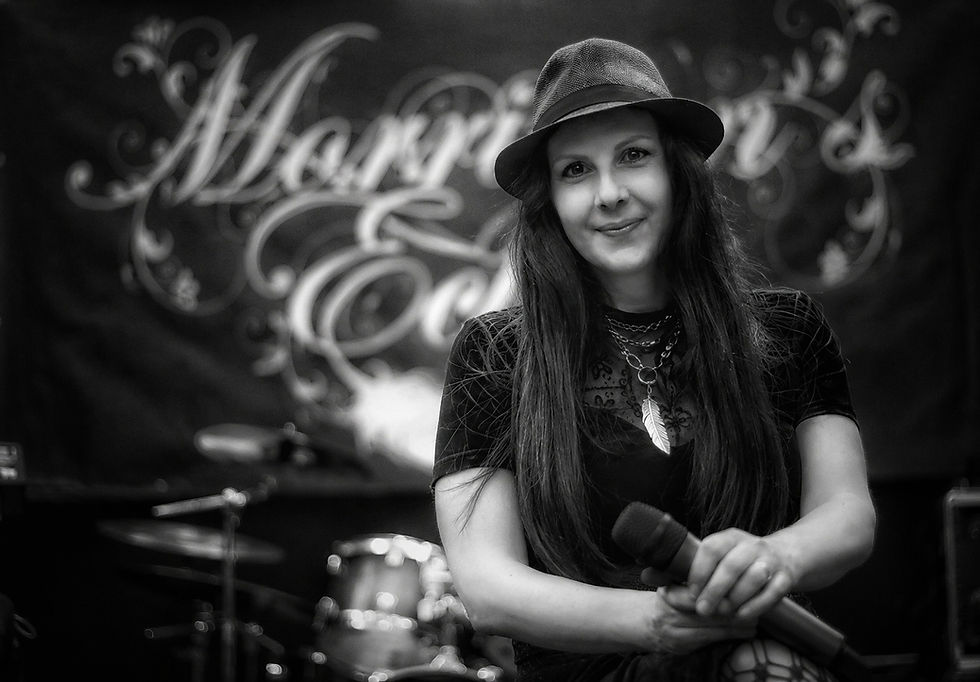
Welcome to another edition of Hawk-IT Interviews! Today, I have the pleasure of introducing a very special guest: Geraldine, the talented lead vocalist of Morrigan's Echoes. Hailing from Luxembourg, Morrigan's Echoes is a modern symphonic rock/metal band that combines powerful storytelling, cinematic atmospheres, and emotionally driven music to create a unique and immersive listening experience.
Over the years, the band has captivated listeners with their blend of soaring melodies, dynamic compositions, and thought-provoking lyrics. Their music takes audiences on a journey through rich narratives, personal emotions, and imaginative worlds, making each song feel like a chapter in a larger story. At the heart of this musical vision is Geraldine, whose passion, creativity, and powerful vocal performances have helped shape the band's distinctive identity.
In this exclusive interview, we dive deep into Geraldine's life and musical journey, exploring how her love for music began, the influences that have shaped her as an artist, and the experiences that led her to become the voice of Morrigan's Echoes. We also discuss the band's formation, their creative process, the stories and inspirations behind their songs, and the challenges and rewards of creating music within the symphonic metal genre.
Whether you're a longtime fan of Morrigan's Echoes or discovering their music for the very first time, this interview offers an inside look at the person behind the microphone and the artistic vision that drives the band forward. From personal reflections and career highlights to future plans and aspirations, Geraldine shares valuable insights that music lovers and aspiring artists alike will appreciate.
Amit Ahuja: To begin at the very foundation of your story, I’d love to step back into your early years. What were the environments you grew up in like—your hometowns, the culture surrounding you, the people in your lives, and the overall energy of your childhood and teenage years? Looking back now, how do you feel those formative experiences, relationships, struggles, and moments of inspiration shaped not only who you became as individuals, but also your emotional depth, artistic perspectives, and the way you approach creativity and self-expression today?
Geraldine: I grew up in Luxembourg in a musical family, but beyond music, I was always a very imaginative and creative child. I spent a lot of time reading, writing stories, and creating worlds in my head long before I ever thought about writing songs.
As a teenager, I went through a strong gothic phase and was drawn to darker themes, mythology, fantasy, and storytelling. Writing became an important outlet for me. I filled notebooks with stories, poems, thoughts, and emotions, not realizing at the time that I was already developing the storytelling skills that would later become such an important part of my songwriting.
like many teenagers, I also experienced challenges, self-doubt, and conflicts that helped shape my perspective on life. Looking back, those experiences taught me resilience, empathy, and the importance of finding creative ways to express emotions.
Today, many of those early influences still live within Morrigan's Echoes. The stories may now be told through music rather than notebooks, but the desire to explore emotions, transformation, and human experiences has remained the same.
Amit Ahuja: Walk us through your musical journeys. When did music first enter your lives in a meaningful way? Was there a defining moment, memory, or experience that shifted you from simply listening to music into feeling compelled to create it yourselves? For the vocalist specifically, what made you begin singing in the first place, and were there certain artists or influences that inspired you to take it seriously rather than seeing it as just a hobby?
Geraldine: Music has been part of my life for as long as I can remember. Growing up in a musical family with a musician father, I was surrounded by music from an early age. I attended a classical conservatory as a child, where
I studied piano, flute, and singing. Because of that, music never really entered my life at a specific moment—it was simply always there.
Singing came naturally as an extension of my musical education. At first, it was something I enjoyed alongside piano and flute, but over time I realized that singing allowed me to express emotions in a way that no instrument could. It became the most personal form of musical expression for me.
As a teenager, I began discovering genres beyond classical music. Bands like Nightwish, Within Temptation had a huge impact on me because they combined powerful vocals with orchestral elements and storytelling. I also listened to bands like Dimmu Borgir and many heavier metal acts, which opened the door to darker atmospheres and cinematic soundscapes. Looking back, those influences probably planted the first seeds of what would eventually become Morrigan's Echoes.
Although music was always important to me, life sometimes took me in different directions. There were periods when I focused on my studies and career, but music never truly disappeared. The melodies, stories, and ideas were always there in the background. At some point I even started learning guitar as I had a Country project where I played guitar and sang.
The real turning point came during the COVID period. Like many people, I found myself reflecting on life, creativity, and the things that truly mattered to me. That was when I decided it was time to stop keeping music in the background and start creating. What began as a personal creative outlet eventually evolved into Morrigan's Echoes with the help of Greg in 2025. He started to put orchestrations to my piano and vocals and then it started to feel like this could be the beginning of an amazing project, a mix between my beloved movie soundtracks and hard metal tunes. That musical project I dreamed about since I was a teenager.
Today, songwriting feels like a natural combination of everything that has shaped me over the years: my classical training, my love of rock and metal, my passion for storytelling, and my desire to transform emotions and experiences into something meaningful that others can connect with.

Amit Ahuja: Since the band comes from Luxembourg, I’d love to know more about the metal scene there. Does Luxembourg have a strong and supportive metal community, and how has growing up in that environment influenced the band’s sound and identity? Were there particular venues, festivals, local bands, or underground spaces that played an important role in shaping your journey as musicians?
Geraldine: The Luxembourg music scene may be small compared to some neighboring countries, but it is incredibly passionate and supportive. We have a surprisingly strong metal community with many talented bands across different subgenres, and there is a real sense of connection between musicians.
One of the things I appreciate most is how willing people are to help each other. If you're a new band and have a question about recording, live shows, equipment, or simply how things work, there is usually someone you can reach out to. Many musicians know each other, and the community is generally very welcoming and supportive. That spirit of collaboration is one of the strengths of the Luxembourg scene.
We are also fortunate to have organizations such as Rocklab and Sonotron, as well as support from cultural initiatives that help musicians develop their projects and grow as artists. These structures play an important role in encouraging creativity and helping bands take their next steps.
At the same time, one of the biggest challenges is the limited number of venues and festivals available for metal bands. Luxembourg has a few well-established metal festivals and dedicated events, but there are many more bands than there are opportunities to perform. As a result, competition for stage time can be quite strong, especially for emerging bands.
I think many musicians would love to see even more opportunities for live metal music in Luxembourg. The talent is definitely there, and so is the audience. We have a loyal and enthusiastic metal community that actively supports local bands, attends concerts, and helps keep the scene alive.
Despite the challenges, we're proud to be part of this community. The passion, dedication, and mutual support between musicians and fans make Luxembourg's metal scene something truly special.
Amit Ahuja: What initially drew each of you toward the genre you’re rooted in today? Beyond the music itself, what was it about the culture—the emotion, intensity, atmosphere, aesthetics, or sense of belonging—that resonated with you on a deeper level? Thinking specifically about your early inspirations, were there particular artists, albums, or songs that helped shape your approaches to songwriting, performance, and musicianship?
Geraldine: For me, the attraction was never limited to a specific genre. What has always fascinated me is music's ability to create emotions, atmosphere, and entire worlds.
I have always been drawn to music that feels cinematic and immersive, whether it comes from classical music, film scores, or metal. Some of my biggest inspirations are composers such as Danny Elfman and Hans Zimmer. Their ability to tell stories through music and create powerful emotional landscapes has had a huge influence on the way I approach songwriting.
Within metal, I am particularly inspired by artists who combine strong storytelling with a cinematic vision. Bands like Ice Nine Kills and Edge of Paradise create much more than songs—they create experiences, characters, and worlds that listeners can step into. That is something I find incredibly inspiring as both a musician and a songwriter.
What resonates with me most is the combination of emotion and imagination. I love music that can transport the listener somewhere else, whether that means exploring personal emotions, dark stories, fantasy worlds, or larger themes about humanity and society.
Those influences have shaped the way I write for Morrigan's Echoes. When I start a song, I rarely think only about melodies or lyrics. I usually see scenes, images, emotions, and stories in my mind first. The music then becomes the soundtrack to those ideas. That's why our songs often have a cinematic quality—they are inspired as much by storytelling and film music as they are by metal itself.
Ultimately, what continues to inspire me today is the possibility of creating music that makes people feel something, relate to something, imagine something, or see a story unfold in their minds. That's the kind of experience I have always loved as a listener, and it's what we hope to create with our band.
Amit Ahuja: Take us back to the formation of the band. How did all of you first connect, and what ultimately led to the creation of this project? Was there a defining moment where everything aligned creatively and personally, making it clear that this was something worth building together? When you first started, what was the original vision for the band sonically, aesthetically, and thematically? Looking at where you are now, how closely does that early vision align with the identity you’ve developed today, and in what ways have you evolved or surprised yourselves along the way?
Geraldine: Looking back, the original vision was actually quite close to what Morrigan's Echoes has become. From the beginning, we wanted to combine emotional storytelling, cinematic orchestration, and heavy music. What surprised us most was how naturally the right people found their place within the project. Each member brought their own personality, strengths, and ideas, helping transform what started as a few piano songs into a real band with its own identity.
One of the most exciting parts of the journey has been watching the creative dynamic evolve. Our first songs were written almost entirely by Greg and me, simply because the band was still taking shape. But as time went on, everyone became more involved in the songwriting process.
Since "Karma" in particular, we've started collaborating much more closely as a full band. Paulo, Eduardo, and now also Vitaly all bring their own musical ideas, perspectives, and influences to the table, and you can really hear the difference in the songs. The arrangements feel richer, the ideas feel more complete, and each member leaves their own fingerprint on the music.
What I love most is that we're learning to understand each other better with every song we write. We're becoming more connected as musicians and as people. Communication has become more natural, ideas flow more easily, and we're developing a shared creative language. Every new song feels more collaborative than the last, and I think that's one of the reasons the band continues to grow and evolve.
Today, Morrigan's Echoes feels very much like the realization of our original vision—but also something much bigger than Greg and I could have created alone. It has become a true band, built on friendship, trust, and a shared passion for creating music together.

Amit Ahuja: Choosing a band name can often be an incredibly intentional and meaningful process. Did you go through different ideas before arriving at your current name, or did it immediately stand out as the right choice? Your band name, Morrigan’s Echoes, carries a strong sense of identity and depth, especially with its roots in mythology and ancient symbolism. Can you take us through the story behind choosing it? What originally drew you to that concept, and how did it resonate with you creatively and personally? Beyond its literal meaning, what does the name represent emotionally, philosophically, or artistically for the band as a whole?
Geraldine: Choosing a band name was something we took very seriously because we wanted it to represent not only our music, but also the stories and themes we wanted to explore.
For me, the Goddess Morrigan immediately stood out as a powerful source of inspiration. I've always been fascinated by mythology, and the Morrigan is a particularly complex and intriguing figure. She is associated with fate, war, transformation, prophecy, and often appears in the form of a crow or raven. What I love most about her is that she cannot be reduced to a single person, role or interpretation. She has many different faces and represents both strength and change.
She embodies transformation and reminds us that every action has consequences. Her stories remind us that change is inevitable and that strength is often forged through adversity. Those ideas resonate deeply with many of the themes we explore in our music—personal struggles, resilience, consequences, growth, and the journey through difficult experiences.
The "Echoes" part of the name felt equally important. In a way, our songs are echoes of stories, emotions, experiences, and ideas that continue to resonate long after a moment has passed. They are echoes of the past, echoes of human emotions, and echoes of the lessons we carry with us through life.
Emotionally and artistically, Morrigan's Echoes represents a voice that tells stories from many different perspectives. It allows us to explore dark themes, but also themes of hope, transformation, and strength. The name gives us a creative universe that is much larger than any individual song.
It also fits our long-term artistic vision. As a band, we are increasingly drawn to the idea of creating immersive and cinematic experiences rather than simply performing songs. The mythology surrounding the Morrigan offers a rich world of imagery, symbolism, and storytelling that can grow alongside the music and inspire future stage productions, visual concepts, and creative projects.
In many ways, Morrigan's Echoes is not just a band name—it is the world in which our stories live.
Amit Ahuja: Many listeners often see a band name as the first gateway into a group’s world, so I’m curious about how Morrigan’s Echoes reflects the ideas, emotions, and atmosphere you aim to express through your music. Does it connect to recurring themes within your lyrics, sound, or visual identity—such as struggle, transformation, fate, spirituality, duality, or rebellion? And as the band has evolved, has the meaning behind the name evolved alongside your music as well?
Geraldine: Yes, as I already mentioned above, there is a strong connection between the name and the themes we explore in our songs.
The name has evolved together with the band. In the beginning it was connected to my fascination with Morrigan and the stories. Today I see it as something much broader. It can become a creative universe we can explore to its fullest.
As our songwriting becomes increasingly collaborative, the meaning has also expanded. It no longer represents only my vision, but the collective imagination of the entire band. Every member contributes ideas, influences and perspectives, which make our world richer with every song we create.

Amit Ahuja: Since the band is still fairly new, I’d also love to hear more about your experience stepping into these roles so early in your journey. For the vocalist especially, what has it been like personally and creatively becoming the frontperson of a metal band? Being the voice and presence at the center of the stage comes with a unique kind of responsibility and energy, so how do you approach performing, connecting with audiences, and representing the identity of the band live?
Geraldine: For me, becoming the front person of a metal band has been both exciting and challenging.
I’ve been involved in music since I was a little girl, but standing at the center of the stage and representing an entire band is a very different experience. When you’re the vocalist, people naturally connect the band with you, so there is a responsibility that comes with that role.
One thing that surprises many people is that I am a really shy person. I don’t naturally seek the spotlight, and being the center of attention has never been something that came easily to me. In many ways, becoming the frontwoman has been one of my biggest personal challenges of this entire journey. Every time I step on stage, I’m pushing myself outside of my comfort zone.
First, I was mostly focused on singing songs correctly and making sure everything went according to plan. But the more shows I play, the more I realize that performing is much more. It’s about creating a connection and sharing an experience with the audience.
What I enjoy most is the storytelling and interacting with the audience. Every song carries emotions, characters or messages, and when I am on stage, I try to bring those stories to life rather than simply sing the notes.
I am still learning and growing as a frontwoman, but with every concert I feel a little more comfortable. I think one of the advantages of being a newer band is that we can discover our stage identity together. We can experiment and learn from each show and from each other.
When it comes to the audience connecting, authenticity is very important to me. I don’t try to become a different person, but I try to share something real. Of course, there is a cinematic and theatrical side to our music, but I want people to feel the genuine emotions behind the songs.
Ultimately, I see my role as a bridge between the music and the audience. My job is not only to sing the songs, but to invite people into Morrigan’s world.
And perhaps that’s why I learned to embrace being on stage, not because I love being the center of attention, but because I love sharing stories and emotions through music.
Amit Ahuja: More broadly, what has it been like being part of a metal band in today’s scene overall—the highs, the struggles, the sense of community, and even the lifestyle that comes with it? Has being in this band changed any of you emotionally, creatively, or personally in ways you didn’t expect? And despite the challenges that can come with pursuing heavy music, what continues to motivate and push you forward during these early stages of your journey?
Geraldine: All of these songs are deeply personal to me as a songwriter, although the music itself becomes a collaborative effort once the band starts shaping it.
Amit Ahuja: Looking more closely at the music you’ve released so far, I’d love to dive deeper into the stories and emotions behind tracks like “Karma,” “The Good Die Young,” “Final Cry,” and “Family Tides.” Can you walk us through the meanings behind those songs and what inspired them lyrically? What kind of emotional or creative headspace were you all in while writing and recording those tracks, and how did the ideas evolve into the final versions listeners hear today? I’m also curious about how personal these songs are to each of you individually, and whether they reflect specific experiences, struggles, relationships, or themes the band wanted to express through the music.
Geraldine: Although each song tells a different story, they all are connected by one thing: they come from real emotions and experiences.
Family Tides is probably with The Good Die Young the most personal songs I have written. It explores complicated family relationships, emotional wounds and the difficult process of letting go when relationships become unhealthy. While the story is personal, I think many people can relate to the struggle of balancing love, disappointment and self-preservation.
The Good Die Young was written as a tribute to a dear friend we lost too soon. It comes from a place of grief, remembrance and gratitude. While writing it was emotionally difficult, but it was also a way of celebrating the impact that a person can have on the lives of others, even after they are gone.
Final Cry was inspired by my concerns about the future of our planet. It reflects feelings of sadness, frustration and helplessness when facing environmental destruction, but also serves as a call to reflect on the consequences of our actions. It combines my personal emotion with a broader message.
Karma explores the idea that our actions eventually return to us. It is less about revenge but more about consequences, accountability and the invisible connections between what we do and what we receive in return. The theme felt particularly interesting because it an be interpreted on a universal level.
Most of the songs begin with an emotion, an image or a story that stays with me and refuses to let go. I usually start with some piano melodies and the lyrics, or a concept, then Greg and me help to transform this into a more orchestral song, and then the rest of the band add their ideas to transform everything into a fully realized song. You can hear the creative process that has become more collaborative in our newer material.
What I love most is when the listeners find their own meaning in the songs. Even when a song starts from a personal experience, it becomes something bigger once people connect their own stories and emotions to it. That’s when music becomes truly powerful.
I’d love to ask each of you this individually—as the lead vocalist, the drummer behind the kit, the bassist holding down the low end, and the guitarist crafting the riffs and melodies: were there any moments during the writing or recording process that truly challenged you, not just as musicians within your individual roles, but also on a personal level? Maybe experiences that pushed you outside your comfort zones creatively, technically, or emotionally, and ultimately became transformative in shaping both the final sound of the music and your perspective as artists moving forward.
Amit Ahuja: The creative journey is often filled with rejection, setbacks, uncertainty, and moments of self-doubt. What advice would you give to emerging artists who are trying to navigate those challenges while staying true to themselves creatively? How can younger musicians transform those difficult experiences into motivation, growth, and longevity rather than letting them discourage them?
Geraldine: Very simple. Don’t give up too soon. Every artist faces rejection, self-doubt and setbacks. They are part of the journey. Create something you believe in and be patient.
Amit Ahuja: Looking ahead toward the future, what does the next chapter hold for both you are individually and for the band as a whole? Are there upcoming projects, collaborations, live performances, tours, or new creative directions that you’re especially excited to explore?
Geraldine: We are currently focused on finishing our debut album and developing our sound. That is our main priority right now and we are very excited about the songs that are taking shape.
At the same time, we are working on a few potential collaborations and projects behind the scenes, but it is too early to reveal details. But there are some exciting ideas we are exploring.
We are also looking forward to playing more shows and continue to grow as a band. Every concert teaches us something new and helps to strengthen our connection. With each other and our audience.
For now, our focus on creating the best music we can and enjoying the journey. We are excited about what the future holds, and we can’t wait to share more of our music with everyone.
Amit Ahuja: On a more personal note, who are three individuals—whether artists, family members, friends, or mentors—who have had a profound impact on your lives creatively or personally? What lessons did they teach you, and how do those lessons continue to influence the way you approach life and music today?
Geraldine: That's a difficult question because many people have influenced me throughout my life, but if I had to choose three, these would probably be the ones.
The first would be my father. We didn't always see eye to eye, but he taught me the value of hard work, discipline, and perseverance. He always believed that if you want to achieve something, whether in music or in life, you must be willing to put in the effort. Looking back, I'm very grateful for that lesson because it still influences the way I approach every project today.
The second would be Greg. Without him, Morrigan's Echoes simply wouldn't exist in its current form. He encouraged me to take my musical ideas seriously and helped transform simple piano songs into something much bigger. Beyond that, he taught me a lot about music production, technology, and all the behind-the-scenes work that goes into creating a band. Whenever I doubted myself, he was often the person reminding me to keep going.
The third would be Margarita Monet from Edge of Paradise. I find her incredibly inspiring, not only as a musician but also as a creative visionary. What impresses me most is how she has built an entire artistic universe around her music while remaining authentic and hardworking. Her determination, creativity, and ability to manage so many aspects of her career are qualities I deeply admire and aspire to learn from.
If I could add a fourth, it would probably be Spencer and Ice Nine Kills as a band. Their ability to combine music, storytelling, visuals, and a complete artistic universe has had a huge influence on how I think about creating immersive experiences through music.
The common lesson I learned from all of them is that passion alone isn't enough. Dreams become reality through hard work, perseverance, creativity, and the courage to keep moving forward even when things get difficult.
Amit Ahuja: Outside of music, what other forms of art or storytelling inspire you creatively? Whether it’s film, literature, visual art, mythology, or something else entirely, what draws you toward those mediums, and how do they influence your creative process and the atmosphere you try to build within your music?
Geraldine: Outside of music, I'm inspired by many different forms of storytelling. Mythology has always fascinated me, because it is filled with symbolism, larger-than-life characters, and timeless themes that are still relevant today.
I'm also a huge fan of film and movie soundtracks. I love the way a great soundtrack can tell a story without a single word being spoken.
As a teenager, I spent a lot of time writing and today, when I write songs, I often start with a story, an image, or a scene rather than a musical idea. In my mind, songs often feel like short movies waiting to be translated into music.
I'm also inspired by books and movies, fantasy worlds, horror, and darker forms of storytelling in general. I enjoy stories that explore human emotions, transformation, difficult choices, and the consequences of our actions. Those themes frequently find their way into our lyrics as well.
Amit Ahuja: If you could place your music into any film—classic or modern—which film would you choose, and what kind of scene or emotional moment can you imagine your songs soundtracking perfectly?
Geraldine: That's a difficult question because I usually don't write songs with a specific film in mind. However, if I had to choose, I think a Tim Burton film would be a fascinating fit.
I've always loved the balance in his work between darkness, fantasy, emotion, and visual beauty. His worlds often feel dreamlike, mysterious, and slightly unsettling, while remaining deeply human and emotional. That's something I can relate to as a songwriter.
I could easily imagine our music accompanying a moment of transformation, self-discovery, or a character standing at a crossroads between darkness and light. Those are themes that frequently appear in our songs as well.
More generally, I think Morrigan's Echoes would fit best in films that combine strong storytelling with a cinematic atmosphere—stories that are emotional, visually rich, and a little bit dark, but still leave room for hope. That's the kind of world we try to create through our music.
Amit Ahuja: There’s often a very real connection between creativity and mental health, especially within emotionally intense genres like metal. How have you learned to navigate that balance throughout your journey so far? What habits, practices, or support systems have helped you maintain your well-being while pursuing something that can be so emotionally demanding and deeply personal?
Geraldine: I think our situation is different from that of full-time musicians because, at this stage, we're balancing the band alongside our everyday lives and careers. All of us have jobs, responsibilities, families, and commitments outside of music.
In a way, that balance helps us stay grounded. Music is something we're deeply passionate about, but it isn't our entire identity. Having other aspects of life keeps things in perspective and reminds us why we started making music in the first place.
Of course, there are moments when it can be challenging to balance rehearsals, songwriting, recording, concerts, work, and family life. But because we do this out of genuine passion, it rarely feels like a burden.
For me personally, music is one of the ways I process emotions and recharge creatively. Spending time with my family, my animals, and in nature helps me maintain that balance as well.
At the end of the day, I think the most important thing is to enjoy the journey. We're not chasing fame—we're creating music because we love it. That mindset takes away a lot of pressure and allows us to focus on what really matters: making meaningful music and sharing it with others.
Amit Ahuja: And finally, as we wrap things up, what message would you like to leave your fans and readers with? For anyone out there currently chasing a dream, struggling creatively, or still trying to find their own voice and identity, what feels most important for you to share with them right now?
Geraldine: I would simply say: it's never too late to chase your dreams.
Morrigan's Echoes only became reality after I turned 40. If there's something you truly love, don't let age, fear, or self-doubt convince you that you've missed your chance.
Take the first step, keep learning, and don't give up too soon. You might be surprised by what becomes possible when you finally decide to believe in yourself.
Amit Ahuja: Thank You So Much to Geraldine for sharing your story with my readers today.

As always, I encourage everyone to explore the music of Morrigan's Echoes using the links provided below. If you enjoy what you hear, be sure to follow the band and their talented lead vocalist, Geraldine, and join them as they continue their exciting musical journey.
Morrigan's Echoes YouTube Page:
Morrigan's Echoes Instagram Page:
Geraldine Instagram Page:
Morrigan's Echoes Facebook Page:
***All photos used by Hawk-IT Media, all property of the following photographer, Patrick from ArtCatching and Geraldine from Morrigan's Echoes***


Comments